Saturday, 19 November 2011

Day 6 - Bird’s Nest camp site – Second day


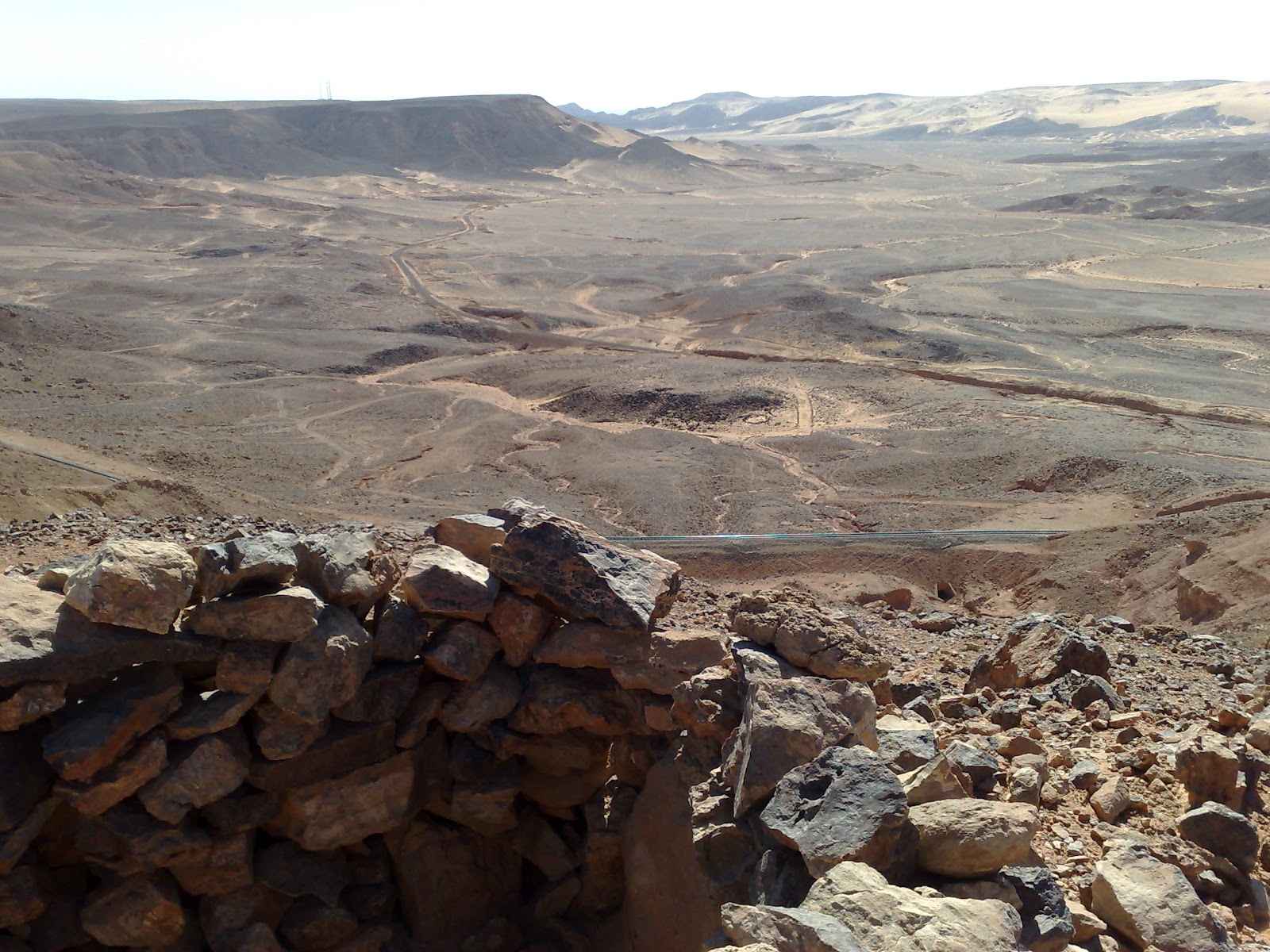
So – why did we go to the Bird’s Nest camp at all? How does it fit in with the rest of the project?  The idea of targeting these tent rings rather than any number of others that we know about, is their proximity to a theoretical quarry, and because we have never previously targeted a tent encampment associated with activities other than forward defence, or in association with the railway. In overall context, this is only the second site that we have examined away from a structure. The tent encampment here was located to the west of the modern Hijaz railway line on flat, open ground. The site is composed of 27 tent rings in two distinct rows, with a separate tent ring located to the south west. The rings vary in size from approximately 450 - 530 cm in diameter and, unlike previous sites excavated by the team these appeared to be more fully constructed, showing in places two courses of layered angular stones. Entrances could be observed in a number of tent rings, but not all. Interestingly, three of them were out of pattern with the remaining rings, which might suggest different use.


Over the two days, the investigation of the rings involved hand excavation in groups of three, the teams often comprising returning, experienced diggers and new members. Hand sieving of the removed fill revealed a mixture of finds including a spoon with star and crescent symbols and Arabic script, Ottoman buttons and buckles, cement bag tags, and surprisingly, a Roman coin.


Following the excavation and the reporting, a full planned record of each excavated ring was completed by the team which undertook the excavation. This involved the careful measurement and scale detailed drawing of the individual stones forming the ring. The completion of the recording was achieved by a full photographic survey of each ring, and the site, and a metal detecting survey of the rings and the spoil heaps.

The excavation here successfully established an Ottoman presence through the collection of finds solely attributable to the period of and around the Great Arab Revolt. No direct link was established between the camp and the quarry, although the sturdy construction of the rings may suggest a correlation. 

The excavation and recording here adds another fascinating piece of the enfolding jigsaw of investigated sites related to the activities associated with our study of the Great Arab Revolt, providing ever more clues towards better understanding of this conflict.

Friday, 18 November 2011

Day 5 - Bird’s nest camp site – first day


Today we moved to a new large site consisting of 26 well established tent rings on a flat plain near the railway, about twenty minutes drive south of where we had been working yesterday. We plan to investigate this site for a couple of days, so this will be an introduction to it and more information and pictures will follow tomorrow.

Team working on the rings at Bird's Nest camp


The evidence of two long parallel lines of tents remained by virtue of the stones that had been used to hold down the canvas at their perimeters. The group was split into 7 teams and each team was allocated a ring to excavate. Over the course of the day the painstaking removal of layers of sand and stones began to reveal characteristic finds in some, giving an insight into their occupants.


Personal seal and ring


Some of the finds today were really interesting – an intact Ottoman army officer’s personal seal, an ornate but damaged ring and several French cement bag tags. We are hoping to be able to trace the person who owned the dated seal and maybe something about them. If we do we will report our findings here on the blog next week. It’s always amazing to be able to link a personal find to a real individual, so we are hoping for success.

The work at this site continues tomorrow, so there will be another report from the Bird’s Nest camp then, together with a lot more photographs of the tam in action and the location itself.

Now for a new feature for the blog. We will be asking some of the volunteers and other team members to paint a pen picture of their reasons for coming on the Project, and how they are finding it out here working in Jordan with us. We begin with Alistair MacLellan, who writes....

“I just came across GARP in Summer 2010 whilst I was job hunting. I had recently graduated with a postgraduate diploma in Arabic language, so as well as the usual London based jobs I was looking further afield to places like Jordan and Egypt to see if there was something more exotic to fill  my time. However I found a job sooner than expected and had to delay joining the project until the current season.

I was not sure what to expect when joining the project.  It is well established – this is it’s sixth season – and what experience I have dated back to my undergraduate degree in 2007. I came to the project blind, not knowing anyone. However the first three days have been spent settling in, including some sight seeing and a day of induction, which has meant I am able to put names to faces.

It is a tight knit project, with any of the guys and girls having been here for previous seasons. Having said that there are many of us – say 40% - new to the project. We are also quite a varied bunch from all over the world. The mix of age, experience and professional background makes some quite effective teams in the field.

I did think we would be doing a lot more field survey. However a lot of research has clearly gone into the fortnight we spend here which has meant we have been able to actually excavate at two sites in two days. I was worried that my lack of practical experience would show but the project leaders were not lying when they said that volunteers of all ages and levels of experiences are welcome here. The site supervisors are relaxed and happy to offer help and advice – but I have noticed that we are allowed to use our own initiative and approach our certain area of the site in whatever way we think best.

My favourite aspect of the day so far is how it has encouraged me to think about the landscape. Most travellers, like T.E. Lawrence, Charles Doughty or William Palgrave put a lot of effort into describing the landscape we currently work in, but to be here and to see it for myself gives a massive insight and sense of appreciation of the challenge faced both by the Arabs and the Ottoman troops defending the railway. When we were excavating the demolished station at Ghadir el Haj it was easy to imagine the small garrison having to rush out into their shallow trenches as the Arabs rushed out of the flat, featureless desert.
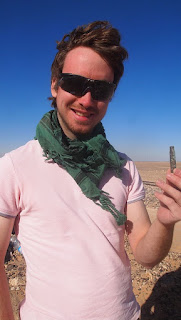
Alistair with the Mauser cartridge he found in the station at Ghadir el Haj


But the main point I would like to make is that, even as we as a project focus on quite a narrow period of time – 1916-1918 – we come across, at every turn, evidence of a landscape affected by human activity. The seventeenth century fort at Unayza. Built to defend the Haj route, in the 20th century it was fortified to defend the railway which it overlooks. The chief engineer’s house at Ma’an is now a museum celebrating Jordanian nationalism. The modern day Jordanian army used the rock cut trenches above Unayza for their military exercises. Villagers dig for rumoured gold and dump their household waste in the trenches above Ma’an. Bedouin use the tent circles at the Bird’s Nest site to shelter their livestock.

Basically the landscape and heritage of the Hijaz railway is not something passive sat out in the desert as I must admit I found it easy to regard it , reading Seven Pillars back in the UK.

It means different things – and is used in different ways – by many groups of people of whom the volunteers on the project are just one. It is really great to be here – just a few days in and the work done here has reminded me how engaging archaeology can be. Well recommended“

Thursday, 17 November 2011

Day 4 - The station (and battle) at Ghadir el Hajj


From Seven Pillars of Wisdom, Maan Fails chapter:

“I asked where Jaffar was, and Nuri said that at midnight he was due to have attacked Jerdun with regulars and guns and Zeid’s Howeitat. I told him of the night flares, which must have marked his success, and while we were glad together his messengers arrived, reporting two hundred prisoners, and three machine guns, while the station and three thousand rails had been destroyed. So splendid an effort would settle the line from the north for weeks, and then Nuri told me that at dawn on the twelfth, (April 1918), yesterday, he, with French Mountain guns and Arab Regulars, and Howeitat under Sherif Fahad, had rushed Ghadir el Hajj station, wrecked it, and five bridges and one thousand rails, getting back only just to see Maluud take Semna.”

Nick Saunders, one of our GARP Directors, read this out at the start of the day today. We were at the very site described in bold in this passage, keen to discover if any evidence of the actual events described could be unearthed by our team on their first real day of digging for the Great Arab Revolt Project 2011.


This is the sort of site most people would simply ignore – a pile of rubble where the station building at Ghadir el Hajj once stood. To the average bystander, little evidence of the main structure of the building remained, just rocks in unrelated heaps with tons of windblown sand piled into every crevice. Most would simply pass by. To our expert archaeologists, an early morning survey looked promising in the sense that they felt features of the building and surroundings of significance might well become apparent with a proper, methodical, analytical approach. This meant moving the sand. And rocks. Tons of them. New team members discovered big time today what desert archaeology is all about!

Under the expert guidance of the site supervisors, small teams began the task of removing and revealing major sections of interest in and around the building. Gradually over the course of the day the inherent structure and form became clearer. This had been an exceptionally well constructed station, with high quality stonework and facings, and quality evident in the cut stone. Much of the previously exposed and ruined stone had long since been taken away, presumably to become part of modern buildings in nearby Ma’an – and who could blame the locals? High quality building materials lying about in the desert - why not recycle them into new property?


In spite of this the foundations remained and we cleared enough material away to expose these, and do some much needed recording of the structure of them and also the other areas revealed by our work today.


But what of the battle and destruction of the building itself? Could anything remain to corroborate the events described in the quotation?

To the west of the rubble remains is a small arc of trenches facing into the desert proper and away from the building and railway. These were identified in a sketch drawn by a passing British pilot in early 1918, and their sand piled frontage still formed a curving defensive position today as it had done then, the night the building was destroyed.

The detectorists began to  investigate inside the trench at one end. Immediately a find! The first fired Mauser cartridge found this season.  They went back to the group to show the new members this, as an example of a diagnostic find, and then carried on their search. It became apparent very quickly that this was indeed the site of conflict. Along the trench Mauser after Mauser cartridge were found at regular, small intervals. With these being every half metre or so,  this is highly consistent with the defending force firing in anger at attackers. And also, in the same area, grapnel balls. Small lead balls which had come from an exploding artillery shell fired at the station. This was indeed evidence of the cover provided by the two guns described in the text. Then, finally, incoming bullet fragments at irregular intervals around the trenches and in the desert land stretching away west.
Detected Mauser cartridge holes dug in the curved trench

It is easy to imagine the stationed men, mainly sleeping at midnight on that day with possibly a lookout or two, harshly awoken by the exploding shells above them as the attack began. Grabbing their rifles they jumped into their shallow trenches to fire into the darkness as the approaching enemy sped towards them under the cover of the two artillery guns. And the incoming force, on horse or camel, firing back as they rushed towards the building, not to hit men necessarily but to pin them down and get close enough for bayoneting or hand guns to be used. Their incoming fire scattered all over the landscape as they made a direct line for the station. The defenders retreat into the building and then it’s nearly all over, as the insurgents reach their target, dismount and lay their charges. Seconds later, the building is destroyed.

Everything we found today is consistent with this and the events described in Seven Pillars. We believe we have direct evidence of this attack happening exactly as described, and we have managed to record and understand this event in a truly unique and important way.

What a fantastic day!


Wednesday, 16 November 2011

Day 3 - Orientation

Today we traveled initially to the station complex at Ma'an. As well as station related buildings, this site also contains the original Royal Hashemite palace, representing the first movement from living in and on the desert to fixed buildings by the First King of Trans Jordan, King Abdullah the First, who was the Emir of Mecca. The building itself is more elaborate than most and was originally built for the chief engineer of the railway. Since then it has temporarily been used as a museum, housing one of the three important battle flags together with other items, and the site itself is now being substantially restored to achieve that end again. Other buildings with working equipment are planned and partly finished demonstrating aspects of railway activity. This place was the hub of military activity which took place in the region, and is adjacent to the Hill of the Birds where one of, if not the best, example of established trench systems and redoubts from the conflict in WW1 in Jordan. GARPers who have been to Ma'an before noted how much this site has been developed since we last visited a few years ago.


We then moved up to the trenches and redoubts themselves to see first hand the remains of these and their location within the landscape. The trenches stretch out along the top of the ridge of the Hill of the Birds and offer a commanding view of the valley floor, representing a convincing defensive position for the station complex and the town outskirts. This site was where the  biggest of the actual battles took place, and in the past we have found much evidence of the conflict here, including both incoming and fired munitions of both sides.


We then went to view a new site - the Fort at Uneyza. This is a 16th century Ottoman fort containing arched rooms and first floor rooms.


After spending some time there and having lunch we crossed the main King's Highway to the other side, where the station buildings at Uneyza remain in various states of repair and refurbishment. This was also a miltarised site and subject to attack during the Arab Revolt. Whilst there some of our party managed to get a ride in a rail cart propelled by a line vehicle, to the great amusement of the local staff.


Then those who felt able enough moved to the base of the nearby trench system at Uneyza, which is physically carved into the rock of the hillside. This involved a challenging walk over difficult terrain.

Tomorrow the main work begins and we move to a site to dig. 

Tuesday, 15 November 2011

Day 1-2 Arrival


We arrived in Amman late on Monday night after a long delay due to an aircraft issue at Heathrow. Immigration took the usual long time for the group, each queuing up to pay our 20 Jordanian Dollars for a visa, and then we set about trying to bring our equipment case in to the country. Fortunately this season all of the paperwork was acceptable and this process only added an extra hour or so to us finally leaving for Wadi Musa, where we eventually arrived at about 4am local time. This is great news as we now have the metal detectors available for the whole of our stay, rather than the last couple of days as per last season.

Later that day we met for a snack lunch and a quick introduction and briefing session. Nick Saunders introduced the project to our group, which includes 8 new people this season as well as several who are attending for their second, third or even fourth/fifth time as volunteers. Sadly Dr Neil Faulkner is unable to be with us at present but hopes to join us soon.


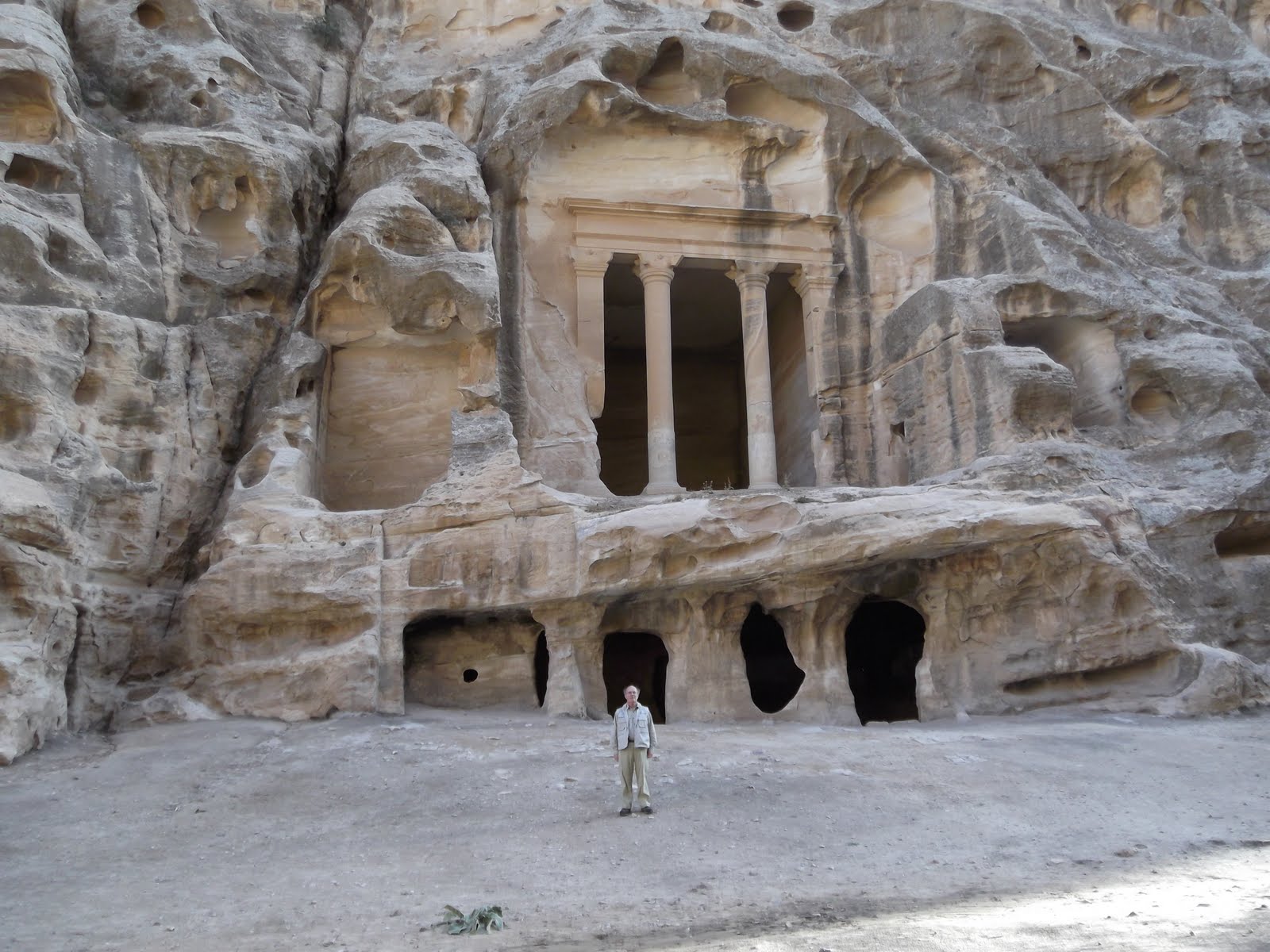
In the aftenoon the group visited some of the local historical sites of interest near to Wadi Musa. These included the neolithic site at Shkarat Msaied, and also Little Petra and Beidha. Images below.


Our plan next is to do an orientation trip for the first day, visiting some of our previous dig sites and some new ones, to prepare the group for the work proper  which starts  on Thursday. Updates as always will be on here, provided the internet holds up (some issues last night, hence the delay in posting this)

Stay tuned for all the news on a daily basis from our ground breaking (sorry!) dig.

Sunday, 13 November 2011

Main party leaves tomorrow.

The advance party travelled yesterday and are now happily enjoying the Edom Hotel in Wadi Musa, where they are busily sorting out the huge array of things needed for the smooth running of the Project this year. Huge thanks to them for all the hard work.

More details of our planned Fieldwork this season:


The 2011 fieldwork season

The Road to Aqaba
This season, we plan to begin the second phase of the Great Arab Revolt Project.

Having explored the militarised landscapes along the Hijaz Railway between Ma’an and Mudawarra during the first five years, we now plan to explore the road between Ma’an and Aqaba. This routeway was heavily contested between June 1917 and September 1918. Regular Hashemite and British forces played a larger role here, so that the conflict combined both conventional and guerrilla elements. We wish to contrast the archaeological imprint here with that already investigated on the railway.
We hope also to initiate a major oral history project in this more heavily settled region.

Abu al Lissan: fortifications and battle site
Known from historical sources, including Seven Pillars of Wisdom, as the site of a major battle between Hashemite and Ottoman forces, we wish to carry out a preliminary reconnaissance of the battle site and assess its potential for future work.

We also wish to explore forts and other military features, once part of the defences guarding the road through the mountain pass near the village. We hope to involve the local community in this work, and we hope that the community will become a source of oral-history data.

The Line from Ma’an to Mudaawra
The survey team will be returning to some of the sites between Ma’an and Mudaawra that were worked on earlier in order to complete some data  collection.


And to give you a flavour of past seasons, here are a few images taken between 2007 and 2010: (click for bigger views)


Hopefully we will have many new discoveries this seasons adding to the emerging understanding of this conflict. Please check back often for updates, or, better still - follow us by clicking the button on the right hand side. Many thanks.

Thursday, 10 November 2011

Just a few days to go...

So - GARP season six is upon us. On Saturday the advance party leaves to pave the way for the main group, who travel next Monday and arrive at our base in Wadi Musa in the early hours of Tuesday Morning. All of us, both new friends and seasoned returners are eager to get there and get started on this year's contribution to the project.

The 2011 season represents a shift in the location and to some extent the direction of the work, with new sites and a development of the researching of the oral history associated with the conflict along the Hijaz railway and in it's surroundings.

In particular, we hope to look at The Road to Aqaba, a major site of conflict in 1917/18 and the fortifications and battle site at Abu al Lissan.

More details of these plans soon - keep checking back to follow our fantastic project.