Wednesday, 23 November 2011

Day 10 - Siddons Ridge Fort

In January 1918 Captain V.D. Siddons, a member of X Flight of the Royal Flying Corps, flew over a region of desert to the north of Tel El Shahm. Siddons is recorded as acting as Lawrence's pilot at some point during the period.  When he returned to base he made a sketch map, from memory, of a fortified position in the region. This map was discovered by one of our team in the National Archive in 2008, and subsequently he visited the area to try to find the site itself.


Today the team went down to the very site in the sketch map drawn by Reverend Siddons. This huge site, with redoubts, trenches, gun emplacements and other features appears to be set in a location that has been occupied in one way or other for centuries, if not millenia. It is also the subject of a descriptive passage in Seven Pillars of Wisdom, which will be included in a later blog - we will be at the site for three days in total.


Work began today investigating some of the main features. At the same time the detectorists swept the slope in front of the ridge and one of the redoubts for evidence of conflict. The preliminary work uncovered several interesting finds but we need to go back again to gather more information before we can make any real sense of the site. One of the difficulties is that the re-use of the site over time has meant that several layers of historical evidence are apparent in some areas. Work will continue on Friday and Saturday here and the blog will be updated as we gather insight.


Today we also have another in our series of reflections on the project by one of this year's members. This is what Zheng Xu thinks about her experience of being with us so far: 

"Being a first time volunteer participating in GARP, I did not know what to expect besides the legendary story of T. E . Lawrence and the desert weather.  I have to admit that I experienced some pre-trip anxiety unlike any other times.  But my experiences tell me that the meaning of this journey will unfold as we become more engaged in the daily activities.


Now we have past the half way point of this journey, after days of hard physical work, my clothing and any exposed surface of my body being covered by sand, numeral "comfort breaks" in any facilities mother nature has to offer, daily lunch of pita bread and hummus and sweet dates, and the mid morning tea breaks to which we all look forward, I have to say this is an unique experience of one's lifetime.


It is unique in the archaeological objectives of GARP.  I am honored to be part of a trailblazing project that is unearthing the evidences of an important part of the modern history that shaped the current landscape of the Middle East. In the current political context, it makes one reflect more on the implications of modern conflicts and war fare.


It is unique in the setting where our work takes place.  Our physical work each day is being rewarded by the wondrous beauty of the Southern Jordanian desert with its shadows and forms dancing in constantly changing light, prehistoric villages and roadside Roman forts, and the silhouette of a line of camels wandering through the desert at dusk...


It is unique in the multinational team that is comprised of experts and volunteers of all age groups with a range of interests, knowledge, skills and kindness towards each other and sensitivity towards the land, people and the work.


To me, the meaning of this journey will continue to unfold in the days and years to come."

Tomorrow the main group will be on a quick tour of some of the other previously investigated sites that we have looked at over the past 5 seasons, which will enable them to 'fill in the blanks' of the work on the project that has been undertaken so far. 


Tuesday, 22 November 2011

Day 9 - Ornamental forts completed and planned

Today we went back to the two ornamental forts to complete their excavation and planning. Many of the team members were involved in this important exercise. Originally we were aware of three of these forts, but already one has been destroyed beyond recognition, and we believe this was done very recently, perhaps even during the last week. For this reason it is vital that we obtain as much information from these features while we can. We have no idea how long they may remain in their present state and identifiably so within the landscape. 


By virtue of their position, scale and proximity to each other it seems possible that these ornamental forts, together with other features in the landscape such as block houses and other fortifications,  form an intervisible sequence of  structures ideally positioned to act as communication links. Our previous excavations have uncovered the metal tapered tips of what might have been a heliograph tripod, which would substantiate the idea that these were used to flash signals up and down the line of the Hijaz. 

An absolutely essential part of the recording of all our activities is the completion of a photographic record. Covering everything from general shots of the features themselves and their place within the landscape, to systematic recording of all excavations and also all finds themselves, this process produces a vital, unique archive of visual record of the project. 

Ali, our official photographer, at work

First battalion RGMDC together with two wannabees. (Royal GARP metal Detecting Corps)
On a lighter note, last season's Goofer Rifles are now joined in their pursuit of GARP related desert activities by the MD Corps, here presenting their arms with two keen team members anxious to become a part of this august group. 

Monday, 21 November 2011

Day 8 - Rest and Recreation.

Firstly today - here is a group photo of this year's team at the stationary carriages on the Hijaz railway at Bir Shedia.


Today was our first rest day. After many days of hard work in the desert, the team took the opportunity to spend some time visiting local places of interest. 21 of us went into Petra, some for the first time and others coming back for a repeat visit. Others went off to view some Copper mines about an hour and a half's drive away, whilst some of the core team visited Mudawwara. Pictures speak louder than words on today's blog, so here is a selection of images taken at various places. More will be added later.
First view of The Treasury from The Siq


Large (10 cm) insect on the steps up to the Monastery in Petra


The Monastery


Copper mine

Sunday, 20 November 2011

Day 7 - A steam engine and some 'ornamental' forts.


On the way to today’s dig site we stopped and spent a few minutes looking at a 1959 steam train and carriages used as a tourist train for the Hejaz railway. Halted in a siding on the line, it was quickly covered in GARP 2011 members, with many taking the opportunity to take atmospheric photos. We also took this year’s group photograph which will be posted on the blog soon.


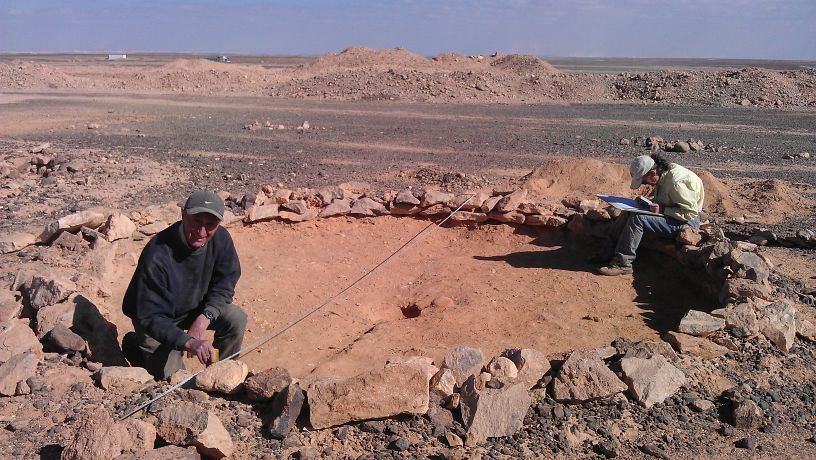
Next we went to begin investigations of two small structures which we have been describing as ornamental forts, largely because some of the features they exhibit seem inappropriate for defence or construction purposes. One of these, which we are calling the round fort, was planned by a small team while the other square fort, which is known as Saleh’s, was also planned while the rest of the group excavated a series of nearby, relatively indistinct, tent rings. This is definitely a work in progress and we are still thinking about how these features fit with the others we have examined in the region.


Now to the next in our series of pen-portraits of group members this season. Here is a contribution from John Raiswell, who is actually making his second visit with us.

“My second season with GARP! My first in 2007 marked the start of a new interest in archaeology, I made new friends and enjoyed both the work and the location very much. So I’m back.

John Raiswell planning an excavated tent ring in Southern Jordan


In preparation for the season I’ve read many of the published papers and I’m impressed with our level of knowledge of the conflict around the Hijaz railway. I particularly liked the paper by Shaqiarat al Salameen, Faulkner and Saunders which showed the nature of the interactions between the conflict and the environment of the Hijaz. Arriving at Wadi Musa, it was a real pleasure to meet old friends from the core team and the volunteers and I’m enjoying getting to know the volunteers I haven’t met before. One big change from 2007 – the majority of volunteers are not from the UK.

When we’d recovered from jet lag over the following couple of days we had an excellent orientation lecture from Nick and later a tour around Ma’an station and the Hill of the Birds. But what a disappointment to see how the trenches at the Hill of the Birds have been destroyed, or at least allowed to decay. I understand the site is to be built up as a tourist destination – it’s to be hoped the Jordanian  authorities can be persuaded to protect this important site.

We began work last Thursday at Ghadir el Haj station. When we arrived it was literally a pile of rubble – the result of a bomb attack by Lawrence. We worked steadily throughout the day and at the end had done, I believe, an excellent job of clearing and revealing the structure. Very satisfying.

Arriving back at the hotel, the core team set to work recording the events of the day, cataloguing finds, photographs and writing reports. All of this done on laptops in the hotel foyer – a huge change from 2007 when I believe the team had only one laptop. Very professional. I was also impressed at how swiftly the team responded to John Winterburn’s revelations about the fortifications around the ‘ornamental’ forts. We spent today (Sunday) in a previously unplanned investigation in the area.

Today we are about half way into the season and I am hoping very much that will be able to get permission to investigate the conflict around the road to Aqaba. This should provide a really interesting contrast with our work around the Hijaz  railway – the contrast between guerrilla warfare and more conventional battles. I hope also we can start work on some of the oral histories planned. These should compliment and flesh out the site work and contribute significantly to our overall understanding of the war in the desert.

Meantime it’s off to the bar for a can of Petra ale and scintillating conversation! Some things never change!”

Many thanks to John for his comments. Tomorrow is a rest day and many of us are visiting Petra. Pictures and a report will be posted later in the day.